Planning Permission For Temporary Industrial Buildings
Under most circumstances adding a new commercial building to your industrial site requires planning permission from the local authority. If the industrial structure is built without gaining planning permission the Council may serve notice on your site, requesting a planning application to regularise the development. Should this be ignored, it may request removal of the building.
As experts in the construction and erection of temporary buildings in the UK, we have amassed considerable experience in this area. We’ve also partnered with a leading firm of town planners who are highly experienced in gaining planning permission for a wide range of industrial clients. For anyone new to the process, they can guide you and advise you every step of the way to ensure you receive planning permission for your building.
While temporary buildings require planning permission under most circumstances there are exceptions. Here is the definitive list of reasons why they need planning permission for temporary industrial buildings, what can happen if one is erected without planning permission and how the process of gaining planning permission is completed.
To start with, here are some definitions:
What Is A Temporary Industrial Building?
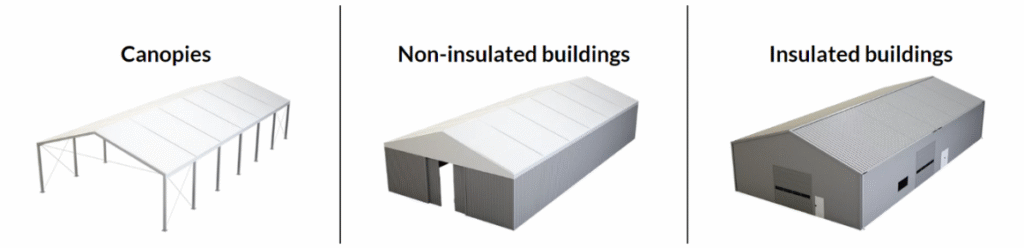
Temporary industrial buildings can fulfil most roles of industrial buildings. They can be canopies that provide great access for vehicles but that keep goods not affected by the weather and workers under a roof. They can be buildings with or without insulation to house goods and processes that require different levels of temperature regulation. They can be warehouses, manufacturing and production facilities, sports halls, storage and maintenance buildings for vehicles and much more.
The main differences between a permanent building and a temporary one is that a permanent building is constructed on foundations usually using permanent fixing such as concrete and mortar.
Temporary buildings are much more flexible. They can be erected without foundations on existing or even uneven ground on site. They can be left up for the short term or indefinitely and they can be taken down, moved and rebuilt. Temporary buildings can be put to the uses of most permanent buildings and they can be extended and converted quickly. Their structure and assembly from the highest quality materials also makes them strong and resilient like permanent buildings.
What Is Planning Permission?
Planning permission is often viewed as an expensive, protracted and elongated rigmarole.
The Planning Portal states that 8 weeks is the average completion time for most planning applications. This may be extended to 13 weeks in the case of larger or more complex projects.
A planning application for the erection or alteration of industrial or commercial buildings is likely to cost in excess of £1000 for complex, large-scale developments. You can use the Planning Portal’s fee calculator for a rough estimate of planning fees.
What Are Building Regulations?
Building regulations are different from planning permission. Basically, planning permission determines if it is acceptable to construct your proposed building in its proposed location for its proposed use.
Building regulations need to be adhered to in order to confirm that the building will be safe to work in and is built well enough. Typical examples of building regulations for temporary buildings include the weight of snow that the roof can bear when it is covered to a certain depth, and the load that the structure can bear when high winds blow against it. These regulation requirements will determine the strength of materials that must be used for different assembly methods.
What Is Permitted Development?
Permitted development covers all the work that can be carried out without the need for planning permission.
Industrial buildings that will not be in place for more than 28 days do not need planning permission. But this is more applicable to event structures rather than industrial buildings, so it is rarely relevant to temporary industrial structures.
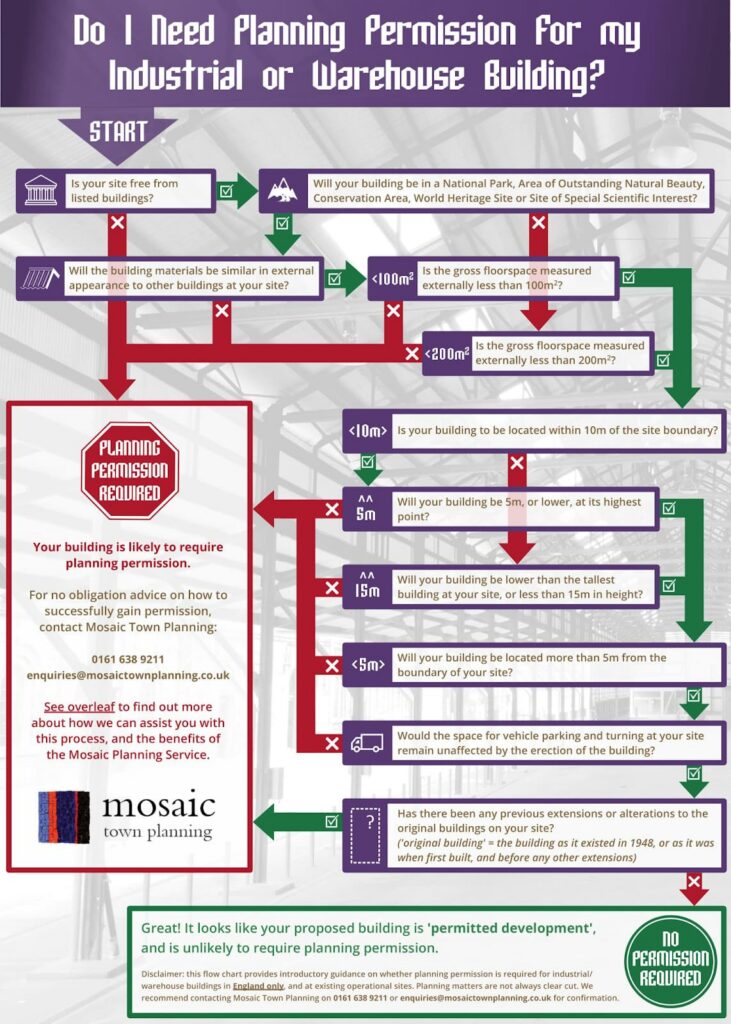
Mosaic Town Planning have produced a comprehensive infographic detailing when planning permission is required for industrial buildings. You can see it in full below.
Why Do Temporary Buildings Need Planning Permission?
Without a set of rules for controlling where and how new buildings are designed and erected, we could all end up living next door to a factory or having a beautiful view blocked by a tower block or seeing a prison built next door to a school. These are all exaggerated examples, but they highlight why we need controls over what can be built and where.
Planning rules have evolved over many years to provide all of us with the best protection from new buildings that are too close, too big, inappropriate for an area or out of character with existing buildings.
However, they do allow the right buildings to be developed in the right areas so that we do have new industrial, commercial and retail premises for trade and commerce, and new housing for moving and growing populations. But they also protect our countryside, populations of rare animals, historical buildings and urban green spaces from development.
What Could Happen If A Temporary Industrial Building Is Erected Without Planning Permission?
In the worst case scenario, local councils have the power to have an industrial building that was constructed without planning permission taken down, unless a retrospective planning application is submitted. There is obviously a huge cost and waste of time involved with this and it should be avoided if possible.
However, with advice from our town planning partners, a retrospective planning application (submitted once the building is erected) could be appropriate. This would require commercial justification for erection of a building without permission (for example, commercial urgency following a new contract/temporary influx in demand).
While there is risk with this approach, knowing what could prevent planning permission from being granted ensures the maximum chance of receiving the required permissions.
How Do I get Planning Permission?
The process for gaining planning permission is involved and can be time consuming, frustrating and costly. The best way to take away the stress and know that experts are dealing with the intricacies and nuances of the process is to hire a company that specialises in property services like gaining planning permission.
Mosaic Town Planning is our partner in this area, and they have yet to fail to receive planning permission for a project to build an HR-Structures temporary industrial building. They can highlight any issues that could prevent permission from being granted so that these can be dealt with before the application is made. They also help reduce the time it takes to get planning permission by ensuring that all documents are prepared to the exact requirements of each council.
Once instructed, Mosaic will begin the process of information collation, working with their architect and HR to produce the plans and Planning Statement. The latter establishes the acceptable principle of development by considering the site, its context, planning history, local and national policy and any technical constraints.
Once submitted, the Council will validate the application should all information required to determine the application has been satisfactorily checked.
Depending on the size of the planned building, the council should process the planning request
within eight weeks for buildings under 1,000m 2 and 13 weeks for anything larger (referred to as
‘major’ development). However, the world post Covid is still experiencing changes in how and where people work, and issues with backlogs. As a result, planning permission can sometimes take longer than the figures quoted above.
Temporary Industrial Buildings And Planning Permission
There’s a lot more to this subject than the brief guide we’ve prepared here, and we always
recommend that customers consult with experts before applying for planning permission. By doing so they always save time and money, and greatly reduce the chance that their application for planning permission is initially rejected.
If you’re a customer of HR-Structures, you will already have dealt with Mosaic Town Planning and benefited from their expertise. If you are not yet a customer of ours or if you are working with another temporary buildings supplier, we strongly recommend that you seek help to gain planning permission for your new industrial buildings.
Contact us if you need advice on planning permission for a temporary industrial building.
Why HR-Structures UK?
With decades of experience delivering aluminium-framed industrial buildings and event structures worldwide, HR-Structures combines technical expertise with a practical, full-service approach. We work with organisations across a wide range of sectors, delivering building solutions that meet demanding operational, programme and budget requirements.
Our philosophy is simple: through experience, engineering expertise and hands-on delivery, we provide tailored building solutions that meet, and often exceed, client expectations.
Testimonials
Read what our customers have to say